
Power, Employment-as-Prison, and the Corporate Uncanny in Severance and Control
The following is an abstract for a conference paper:
“Behind the baroqueness of images hides the éminence grise of politics.”
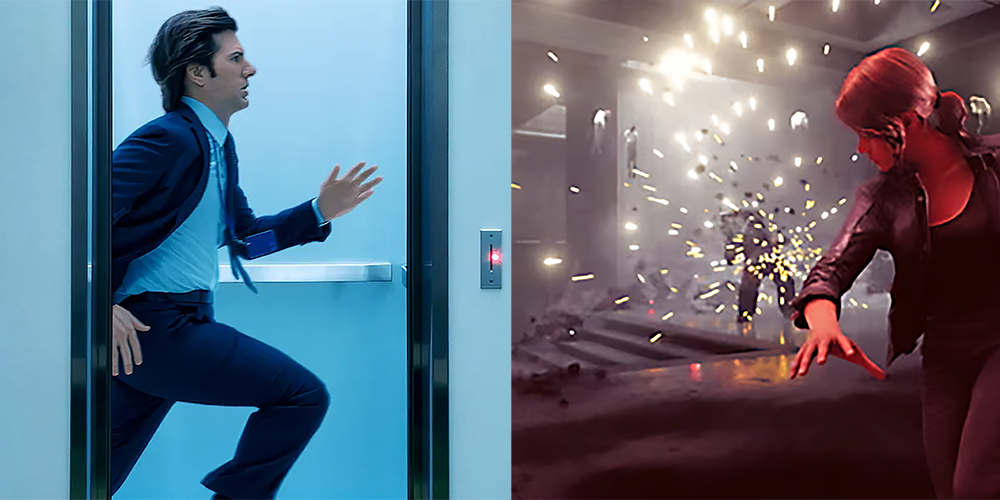
In both Apple TV+’s surreal television drama Severance (2022) and Remedy Entertainment’s video game Control (2019), office workers confront uncanny structures of power within labyrinthine workspaces from which they cannot escape. Overseeing these spaces is a mysterious “Board,” a governing entity that communicates only through a translator or interlocutor, when it is not communicating through silence. In Severance, The Board listens and watches and occasionally exerts its will through a smiling interpreter whose HR-rep friendliness fails to mask her sinister intentions. In Control, the PC is the unwilling Director of the Federal Bureau of Control, carrying out the will of The Board, a collective of interdimensional beings who commune with her via imprecise translations that blend corporate jargon with cosmic psychobabble. The Board, in both properties, literalize Marshall McLuhan’s contention that communicative media are messages unto themselves but these protheses extend not the bodies of common workers but the authority of unseen entities at the very top of the institutional hierarchy. They represent Lewis Mumford’s “megamachines,” subsuming human welfare beneath the rubric of power structures that are opaque and self-reinforcing. The communicative metonymies that refuse to communicate—a crackling PA system/interpreter in Severance and an inverted pyramid emitting muffled speech with inscrutable subtitles in Control—express a real-world horror of late capitalism: The complete, public, and perpetually-reinforced severance of workers from the mechanisms of power and their lack of control in what I am calling the “corporate uncanny.”

On the other side of the power divide from The Board, workers are a literal slave class—members of what Giogio Agamben terms Homo Sacer, who are simultaneously indispensable and expendable. They are stripped to bare life so their labor and bodies can be controlled, partitioned, or sacrificed without legal or moral consequence. In Severance, severed “Innies” spend their entire lives within the twisting halls of the Macrodata Refinement Division of Lumon Industries, collating data they cannot interpret. When “Outies” retire, their Innies ceases to exist, and so the half-life of work is the only reality or opportunity open to their severed identities. In Control, Jesse Faden is elevated to Director of the FBC and yet her ascension bestows obligation without any real power. Indeed, her only option is to become the policing apparatus of The Board, killing employees who have been infected by a malevolent entity called The Hiss. When she finds these workers, they hang in midair, chanting in unison, and they will attack if they are not put down. Both texts imagine a world in which abstract corporate or bureaucratic authority destroys human subjectivity by choreographing workers into ornamental patterns that, according to Seigfreid Kracauer’s “Mass Ornament,” reflect the impersonal, fragmented logic of modern bureaucratic and administrative systems. In these two works of contemporary media culture, we see that the future of institutional power is not about the individuals on either side of the power divide: It is about how organizations in the abstract become self-reinforcing megamachines—media systems that control the very conditions of reality that dictate how we understand ourselves, our jobs, and one another.
Works Cited
Agamben, Georgio. Homo Sacer: Sovereign Power and Bare Life. Translated by Daniel Heller-Roazen, Stanford U. P., 1998.
Baudrillard, Jean. “The precession of simulacra.” Simulacra and Simulation, Translated by Sheila Faria Glaser, U. of Michigan P., 1994, pp. 1–42.
Control. Remedy Entertainment, Distributed by 505 Games, PS5 Edition, 2019.
Karim, Muzaffar. “Factory or Corporation: What Severance Gets Wrong.” Inverse Journal, Inverse Praxis Foundation, 10 Mar 2023.
Kracauer, Seigfreid. “The Mass Ornament.” The Mass Ornament: Weimar Essays. Translated by Thomas Y. Levin, Harvard U. P., 1995.
McLuhan, Marshall. Understanding Media: The Extensions of Man. The MIT Press, 1994.
Miller, Dylan Reid. “The Grim Barbarity of Capitalist Designs: Class Conflict, Corporate Dystopia, and the Sacred Gaze in Severance.” Reintegrating Severance, edited by Nora M. Isacoff and Jennifer Dawes, Palgrave Macmillan, 2024, 37-59.
Mumford, Lewis. The Myth of the Machine: Technics and Human Development. Harcourt Brace Jobanovich, Inc., 1967.
Severance. Created by Dan Erickson, Apple TV+, 2022.